

Views: 0 Author: Site Editor Publish Time: 2026-07-21 Origin: Site


Why Push Rod Diameter Changes Camera Performance
Differences Between 4.8mm, 5.3mm, 6.8mm, 9mm, and 11mm Rods
How to Match Diameter to Pipe Conditions
Why the Camera Head and Reel Must Be Compatible
Common Buying and Operating Mistakes
FAQ
Conclusion
Selecting a push rod only by its maximum length can leave a sewer inspection camera unable to pass bends, transmit useful pushing force, or support its camera head. A thin rod may navigate compact drains but buckle during a long run, while a thick sewer camera coil may push farther yet resist tight turns. The correct choice depends on pipe diameter, route geometry, camera-head size, inspection distance, and reel design. Comparing 4.8mm, 5.3mm, 6.8mm, 9mm, and 11mm options helps buyers choose a system that remains controllable throughout the inspection.
A sewer inspection camera push rod must perform two opposing tasks. It needs enough flexibility to follow elbows and changes in direction, but it also needs sufficient stiffness to transfer the operator’s force from the reel to the camera head. As rod diameter increases, its resistance to bending generally increases sharply. This improves forward pushing over long or open pipe sections, although the same stiffness can make a camera harder to steer through short-radius elbows, traps, and offset joints.
Diameter also influences how the rod behaves after entering a larger pipe. A thin push rod sewer camera cable may bend into loops or press against the pipe wall instead of advancing the head. This behavior, often called buckling, consumes pushing force and reduces the operator’s control. A thicker rod resists that deformation, but it requires more space to turn and usually needs a larger reel basket.
The complete system matters more than diameter alone. QYTeco’s Push Rod Sewer Cameras demonstrate how different rod diameters can be paired with different camera heads and inspection configurations. Buyers should therefore compare the push rod, head, frame, reel, counter, and connector as one system rather than treating the cable as an isolated component.
Each diameter represents a different balance between maneuverability and pushing strength. The smallest option is not automatically the most practical for every residential pipe, and the thickest option is not automatically more durable in every working route. The most useful comparison considers bends, distance, camera weight, and the space available inside the pipe.
A 4.8mm diameter sewer camera is intended for restricted access and smaller pipe routes where turning ability matters more than maximum pushing range. Its slim rod can follow tighter changes in direction and works well with a compact camera head. However, the operator must feed it gradually because excessive force can make a flexible rod bow inside a wider pipe instead of moving forward.
A verified QYTeco configuration combines a 4.8mm fiberglass reel with a 12.8mm camera head. The system offers several reel-length configurations and is designed for smaller pipelines. This makes the 4.8mm class relevant to narrow branch lines, compact access openings, wall cavities, and similar restricted inspection routes.
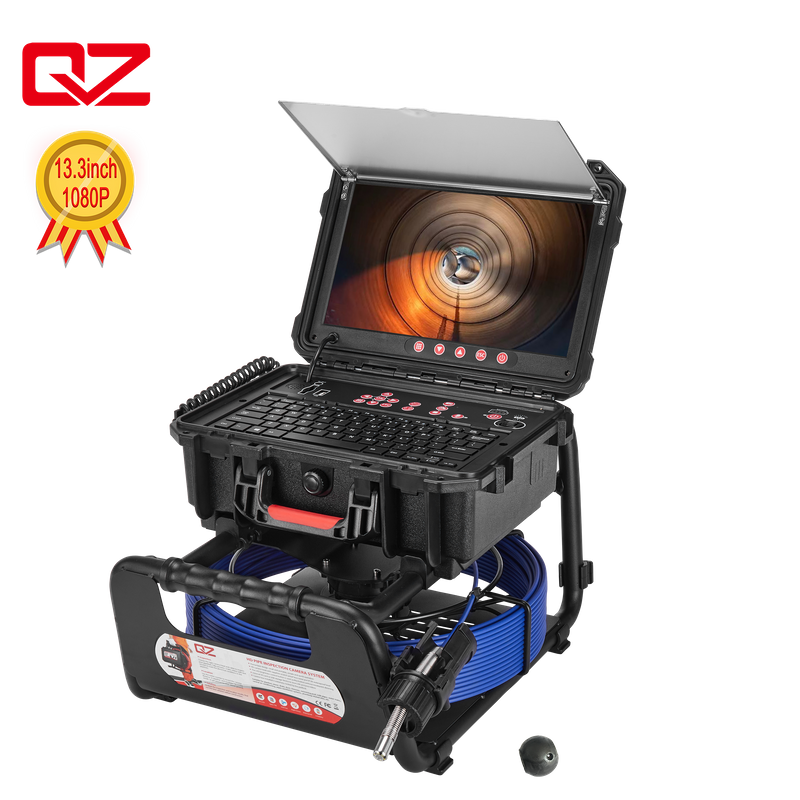
A 5.3mm sewer camera coil provides slightly more body than a 4.8mm rod while retaining good flexibility for residential drains, HVAC ducts, and narrow industrial lines. It is often suitable when a very thin rod feels difficult to control but a 6.8mm cable would be too stiff for the expected bends. The difference of half a millimeter appears small, yet it can noticeably change how force is transmitted during a longer push.
QYTeco’s 5.3mm Fiberglass Push Rod has a fiberglass core with a protective outer layer and is available in multiple length configurations. The rod offers a useful balance between flexibility, tensile strength, and controlled feeding. Actual bend performance still depends on the attached camera, spring, connector, and pipe conditions.
A 6.8mm diameter sewer camera provides stronger pushing control for medium-length inspections without moving into the heavy-duty dimensions of 9mm or 11mm systems. It can be a practical choice for plumbers who inspect both residential laterals and larger commercial drainage routes. Compared with a 5.3mm rod, it normally advances more confidently through long sections, although it may require wider bends and more deliberate handling.
QYTeco offers sewer inspection camera configurations that pair a 6.8mm fiberglass push rod with a larger camera head. This arrangement illustrates why 6.8mm is commonly treated as a middle category rather than simply a thicker replacement cable. It is suitable when a buyer needs more pushing stability without giving up all the maneuverability required for normal drainage bends.
A 9mm diameter sewer camera is designed for applications where long-distance pushing and stability are more important than passing compact household traps. The thicker rod resists bowing in larger pipes and can support a larger camera assembly. Its disadvantages are increased reel size, greater system weight, and reduced willingness to follow tight-radius elbows.
QYTeco’s 9mm sewer inspection configuration uses a heavy-duty reel and a larger camera head for wider pipeline applications. This combination shows how the rod, camera size, and reel construction must be matched for larger pipe inspection. A buyer should not install a 9mm replacement rod on a small reel or compact camera merely to gain reach, because the entire cable reel sewer camera structure must accommodate the added diameter and stiffness.
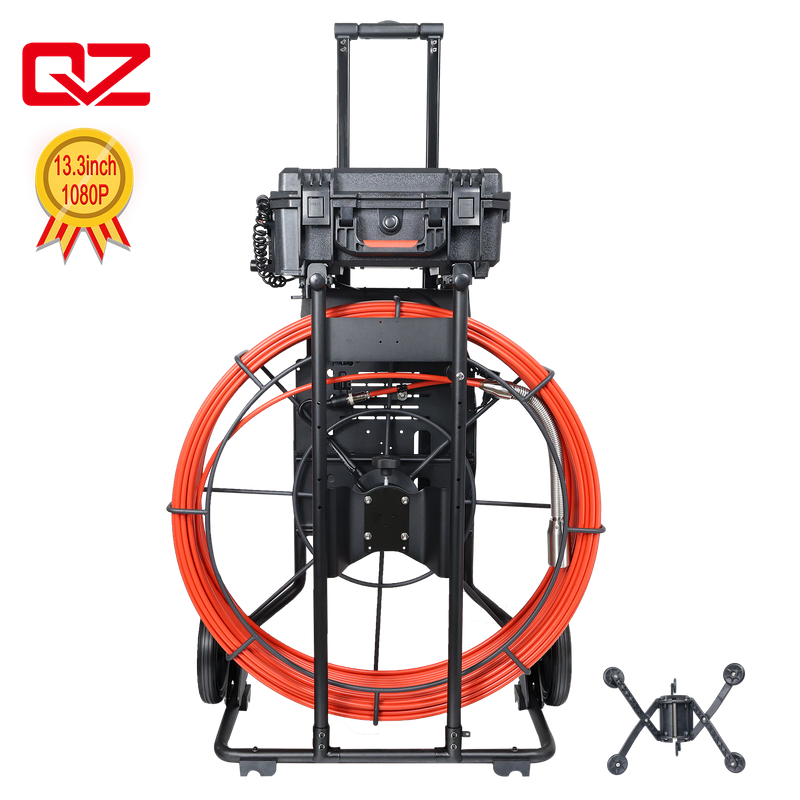
An 11mm rod belongs to the heavy-duty end of push-camera equipment. It is selected when the sewer inspection camera must travel a substantial distance, carry a larger head, or resist friction and sag in wider pipelines. The increased stiffness can deliver strong forward control, but it also raises the minimum turning space and makes the reel larger and heavier.
An 11mm sewer camera coil is generally unsuitable for small household traps, compact branch lines, or routes containing several sharp elbows. It is more appropriate for open municipal, industrial, or large commercial pipelines where forward thrust and cable stability are the main priorities. Pipe material, deposits, elevation changes, camera-head design, and centering skids can still reduce the practical inspection distance.
Rod Diameter | Relative Flexibility | Relative Push Control | Typical Selection Reason | Main Limitation |
|---|---|---|---|---|
4.8mm | Very high | Lower | Small access points and tight bends | Can buckle during long pushes |
5.3mm | High | Moderate | Narrow drains requiring better control | Limited support for large camera heads |
6.8mm | Medium | Strong | Mixed residential and commercial work | Less suitable for compact traps |
9mm | Lower | Very strong | Long runs and larger pipelines | Larger and heavier reel system |
11mm | Lowest in this group | Heavy-duty | Large pipelines requiring strong forward thrust | Requires wide bends and a compatible reel |
Start with the most difficult section of the route rather than the largest pipe diameter. A sewer inspection camera may enter through a wide cleanout but immediately encounter a compact elbow, offset joint, or transition into a smaller branch. Selecting a rod only for the main line can make it impossible to pass that restrictive section. Conversely, choosing an extremely flexible rod for one tight bend may create control problems during the remaining straight run.
Use the following sequence before specifying the cable:
Record the minimum pipe diameter and the actual cleanout opening.
Count sharp elbows, traps, junctions, and changes in elevation.
Estimate the longest uninterrupted push distance.
Confirm the camera-head diameter, spring length, weight, and skid size.
Decide whether bend mobility or long-distance thrust is the higher priority.
A short residential route with several direction changes usually favors 4.8mm or 5.3mm. A mixed route with moderate bends and a longer straight section may justify 6.8mm. Larger mains and extended inspections are more appropriate for 9mm or 11mm systems, provided the access and bend radii can accommodate them. A successful sewer inspection camera selection therefore follows the full route rather than a single nominal pipe measurement.
Pipe condition must also influence the choice. Smooth PVC normally creates less friction than old cast iron, clay, or concrete pipe with rough joints and accumulated deposits. A thin rod that performs well in a clean test pipe may lose control quickly in a corroded or partially blocked line. Buyers should allow a practical margin for friction instead of selecting the smallest possible cable based only on pipe diameter.
Push rod diameter cannot be separated from camera-head size. A small camera on an unnecessarily thick rod may lose the bend advantage that made the compact head useful. A large or heavy head on a very thin rod may be difficult to push, especially when a centering skid, self-leveling mechanism, or locating transmitter adds weight and resistance. The spring behind the camera also affects turning behavior, so two systems using the same rod diameter may perform differently.
Reel compatibility is equally important. QYTeco’s Sewer Camera Cable Reels include multiple fiberglass push rod diameters for different sewer inspection camera systems. The reel basket, guide path, counter mechanism, brake, and cable outlet must fit the rod diameter. Installing a thicker replacement rod can cause rubbing, inaccurate feeding, or poor winding, while an undersized rod may not remain properly guided.
Connector and electrical compatibility must also be confirmed. A replacement sewer camera coil may contain signal conductors for video, a meter counter, a locating transmitter, or other functions. Matching only the mechanical diameter does not guarantee that the camera head and control box will communicate correctly. Before ordering, verify the camera model, connector type, reel type, required length, signal format, and operating functions.
Cable length must also fit the reel capacity. Installing more push rod than the frame was designed to hold may cause overlapping coils, uneven winding, or interference with the counter wheel. A correctly matched cable reel sewer camera should feed smoothly, remain organized during retrieval, and avoid sharp local bends that could weaken the fiberglass core.
One frequent mistake is buying the longest available sewer inspection camera cable without considering how added length affects pushing and storage. A flexible 50-meter rod does not automatically deliver a usable 50-meter inspection in a route with several elbows. Every bend, rough joint, deposit, and elevation change consumes part of the force applied at the reel. Practical reach should therefore be evaluated under representative pipe conditions.
Another mistake is forcing a rod after forward movement stops. Additional pressure can make a small rod loop inside the pipe, damage its outer layer, or overload the camera connection. Withdraw the camera slightly, rotate or reposition the rod, and attempt the bend again with controlled movement. If repeated attempts fail, the camera head, skid, spring, or push rod may be unsuitable for that route.
Selecting a push rod solely by price can also create problems. A smaller diameter may reduce reel size and material use, but it may not deliver enough pushing control for the intended distance. A larger rod may appear more durable, yet it can prevent the camera from passing the bends encountered in everyday work. The most economical sewer inspection camera is the one matched to the actual application rather than the lowest-priced or thickest available option.
Maintenance affects performance as well. Sludge and abrasive particles increase friction as the cable moves through the guide and reel. Clean the rod after use, inspect the surface for cuts or exposed fibers, and wind it evenly without sharp localized bends. Proper storage protects the sewer inspection camera cable from unnecessary deformation and makes changes in handling easier to identify before the next inspection.
Choose a sewer inspection camera push rod according to the most restrictive bend, required pushing distance, camera-head assembly, and reel compatibility. The 4.8mm and 5.3mm options prioritize maneuverability, 6.8mm offers a practical balance, and 9mm or 11mm rods support heavier, longer-range work. Diameter alone cannot guarantee successful access, so the complete route and system configuration must be evaluated. QYTeco, a sewer camera manufacturer and supplier, provides several push rod and reel configurations that help buyers match inspection equipment to different pipeline conditions.
A: The correct diameter depends on the smallest pipe section, number of bends, camera-head size, inspection distance, and the amount of forward pushing control required.
A: A 4.8mm rod is suitable for many compact household routes, particularly when paired with a small head, but actual suitability depends on bends and access size.
A: A 5.3mm rod favors flexibility and narrow access, while a 6.8mm rod normally provides stronger pushing control for longer runs and moderately larger pipelines.
A: Choose a 9mm system for larger pipes and extended inspection distances where strong forward control matters more than passing tight household traps or compact elbows.
A: An 11mm coil is generally suited to wide, relatively open pipelines where heavy-duty pushing strength is more important than flexibility through sharp bends.
A: Only after confirming reel capacity, guide dimensions, connector type, camera compatibility, signal wiring, counter operation, cable length, and the approved replacement configuration.


